Short answer: Using Kling Motion Control, the generated clip is yours to use under the license Kling grants in its Terms of Service — not under the tool's marketing language, and not automatically in the public domain. Ownership and "what you're allowed to do with it" are two different questions. The license tells you what Kling permits; your input rights tell you what you were allowed to feed it; the publishing platform tells you what you can do once it's out there. Most "can I use this commercially?" problems come from skipping one of those three, not from the model itself.
This guide is built from how AI-generation platforms generally structure their terms and how publishing platforms generally treat synthetic media. It points you at what to verify. It is not legal advice, and it does not quote Kling's exact clauses — those change by plan and region, so the only authoritative source is the Terms of Service attached to your own account.
The three layers that decide your rights
Rights on a generated clip are not a single switch. They stack. Think of three layers, and you need every layer to hold:
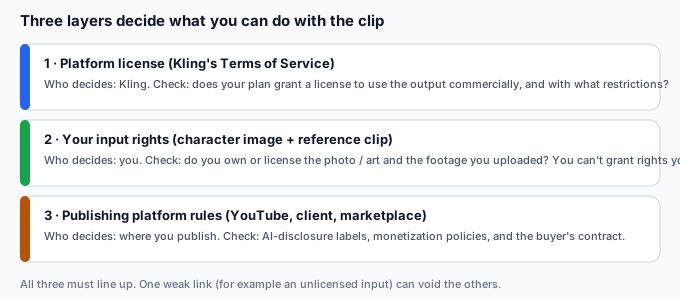
| Layer | Who decides | What to check |
|---|---|---|
| Platform license (Kling ToS) | Kling | Does your plan grant a license to the output, and does that license cover commercial use? Some tiers are personal-only; some resellers advertise "full commercial rights" that differ from Kling's own terms. |
| Your input rights | You | Do you own or license the character image and the reference clip? You cannot grant rights you don't hold, no matter what the output license says. |
| Publishing platform rules | Where you post | AI-disclosure labels, monetization eligibility, and any buyer contract. A clip can be "yours" and still be rejected or demonetized for breaking platform policy. |
Can you post it on YouTube and earn?
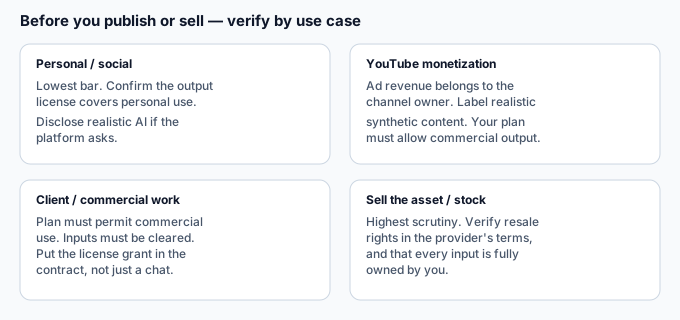
Generally yes, with two conditions. First, the ad revenue from a monetized channel belongs to the channel owner — the platform that generated the clip doesn't claim it. Second, platforms such as YouTube require you to disclose synthetic or AI-generated content that realistically depicts people or events; failing to label realistic synthetic media can affect eligibility or lead to removal. And the commercial-use permission has to come from your Kling plan, not from a free or personal tier that only covers non-commercial use. If your plan permits commercial output and you label where required, a Kling Motion Control clip is no different from any other asset on your channel.
Can you sell it to a client?
Client work is commercial use, so the same plan-level permission applies: your subscription must allow commercial use of generated output. Beyond that, the part people forget is the inputs. If the character image is a photo of a real person, or the reference clip is someone else's footage, you need rights to those too — and the safest move is to put the license grant in the written contract, not just a chat message. A clean deliverable is: "I generated this with a tool whose commercial terms I'm licensed under, using assets I have the right to use, and I grant you X rights to the result." Spell out X.
Do you own the character image and the reference clip?
This is where most "rights" problems actually start, and it's the one layer fully under your control. The character image is whatever still you feed in — a photo of yourself, a rendered avatar, a product shot. If it's a photo of someone else, their likeness and the photo's copyright are theirs. The reference clip supplies the motion; if you downloaded it from somewhere, that source has its own license. Using motion extracted from copyrighted footage doesn't make the footage yours. The practical rule: use your own image and your own footage, or license both, and the input layer is solved before you ever hit generate.
Common myths to drop
- "AI output is automatically public domain." No. Public domain and "I have a license from the generator" are different things; the generator's terms govern, and most keep the output under a license to you, not to the world.
- "Because I made it, the platform can't claim it." The platform grants you a license under its terms; if those terms say non-commercial only, commercial use breaks them regardless of who clicked the button.
- "Realistic AI video doesn't need a label." On platforms with disclosure rules, realistic synthetic media generally does need labeling. "It's obviously fake" is not the test they use.
- "Every plan includes commercial rights." Not necessarily. Plan tiers differ, and third-party resellers sometimes advertise broader rights than the underlying provider's own terms — confirm for the account you actually use.
Practical checklist before you publish or sell
- Read the output-license section of your Kling plan's Terms of Service. Note whether commercial use is permitted and any attribution or restriction attached.
- Confirm your inputs are yours or licensed. Character image and reference clip — keep a note of where each came from.
- Label synthetic content where the platform requires it. Especially realistic people or events on YouTube and similar sites.
- For client or resale work, put the grant in writing. State what rights you're transferring and what you're keeping.
- Keep the generation record. A screenshot of the prompt, the plan tier, and the date is cheap insurance if ownership is ever questioned.
After you generate: remove the background
Whatever you plan to do with the clip commercially, it usually comes out on the reference clip's background. To place your character on a clean scene — for a YouTube thumbnail, a client deliverable, or a product shot — the practical next step is a background remover. Bring the clip to greenscreencut.com and either key out a green/blue backdrop or use the remove-after mode, then export a transparent WebM or a PNG-sequence zip you can composite anywhere. A background-free, rights-cleared clip is the asset you actually deliver.
Bottom line
Kling Motion Control does not "take" your clip, and it doesn't automatically make it free for anyone — it grants you a license under its terms, and your ability to use the result commercially depends on three aligned layers: Kling's output license, your rights in the inputs, and the rules of where you publish. Read the terms for your actual plan, own or license your image and footage, label synthetic media where asked, and write down the grant for any paid work. Do those, and the clip is a usable, defensible commercial asset. Skip one, and the weakest link is what decides.